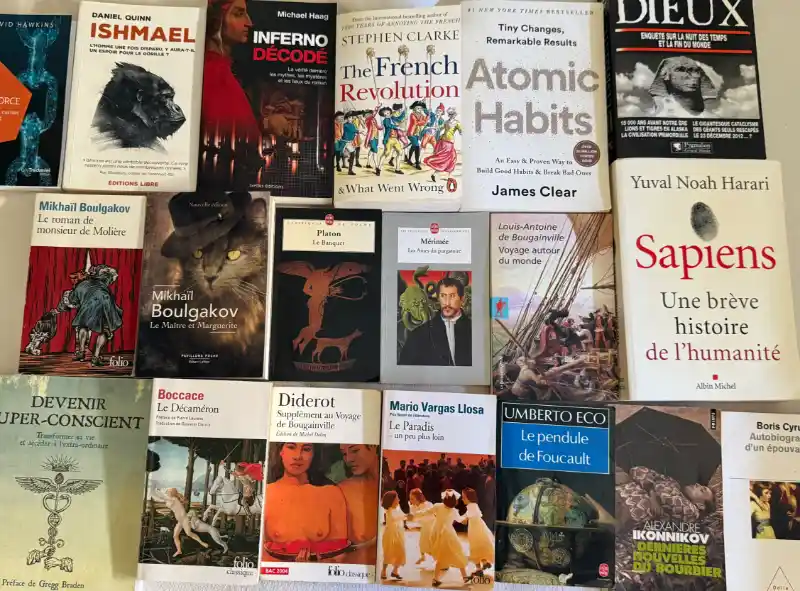
Reading: a bona fide mental training tool?
Concentration, mental endurance, emotion regulation, openness: what if reading a book were much more than a hobby?
We readily train the body through repetition. We also know that a high-performing mind is not built only in competition moments, but through ordinary habits: those that develop our capacity to stay present, tolerate discomfort, understand a situation and avoid immediate reactions to every stimulus.
In that sense, reading books can become a genuine mental training tool. Not a spectacular weapon, nor a method that would replace structured coaching or training, but a regular practice that engages several capacities essential to performance.
That said, it’s necessary to specify what kind of reading we mean: reading long enough to enter an argument, a narrative or a world; fiction as well as essays, biographies, history, science or philosophy; authors from all eras, cultures and sensibilities.
Here are five reasons, supported by cognitive psychology and neuroscience, to include reading in your mental training.
1. Reading trains concentration and mental endurance
Reading a book requires maintaining a goal: following an idea, remembering characters or arguments, linking the current page to previous ones and resisting distractions. Reading therefore engages sustained attention and working memory. A meta-analysis of 197 studies actually found a significant relationship between reading and working memory, although correlation alone does not prove that reading automatically improves that memory.
The relevance for mental training is obvious. In competition, an exam or a tough professional situation, you must stay on task after the initial excitement fades. You must continue despite fatigue, occasional boredom or a lack of immediate results. That is precisely what we call mental endurance.
A book doesn’t reward every finger movement. Sometimes you must get through a denser page, accept not understanding everything immediately, go back or wait several chapters before an element makes sense. This experience trains less “suffering” than the capacity to not flee the first discomfort. It restores a productive place to the frustration.
Did you know? A brain network associated with sustained attention helps predict the ability to recall what was read. In other words, reading is not just recognizing words: it requires actively maintaining the thread of the experience.
From a mental training perspective, reading twenty to thirty minutes without checking your phone can become a simple concentration exercise: one task, a set time, a sustained commitment.
2. Reading turns words into mental simulation
When we read, the brain does not receive a preassembled world of images, voices and music. It must build it. It produces representations, anticipates, fills in what is unsaid and simulates places, actions, intentions and emotional states.
Neuroimaging work shows that vivid narrative passages and social content do not engage exactly the same brain sub-networks. Fiction reading notably recruits systems involved in simulating scenes and understanding others’ mental states. One study of people reading a novel also observed temporary changes in brain connectivity; this interesting result remains exploratory and does not mean a novel “reprograms” the brain long-term.
For an athlete, a leader or a student, this simulation ability is valuable. It supports imagining multiple scenarios, anticipating a difficulty, envisioning a possible response and recognizing that the first interpretation is not always the only one.
Reading does not replace the visualization used in performance. It does, however, cultivate a neighboring terrain: forming internal representations from incomplete elements. It can therefore enrich what we might call the adaptive unconscious: the set of learnings, cues and associations the brain can access quickly when it must decide under pressure.
3. Reading creates a space to regulate emotions and pressure

I myself devour books. I think what matters is the variety of topics and authors.
Reading can be absorbing. This “narrative transportation,” studied in psychology, combines focused attention, imagery and emotional engagement. When you sink deeply into a book, competing demands temporarily recede. The mental load is not necessarily removed, but it stops occupying the whole space.
That is why reading can produce a calming sensation close in some respects to meditation: attention directed to a single object, behavioral slowing, temporarily turning off notifications and reduced task-switching. It would, however, be excessive to say that reading is meditation or that every book scientifically reduces stress. Content, reader and context matter; some texts can be upsetting, worrying or trigger memories.
The mental benefit also lies elsewhere: a book allows a gradual encounter with complex emotions. You can feel fear, anger, shame, hope or sadness while remaining within a safe frame. That distance sometimes helps put words to what you feel, to observe a reaction rather than be overwhelmed by it, and to expand your emotional repertoire.
A longitudinal study of 231 students also associated recreational reading with reduced psychological distress over the academic year. This finding supports a possible protective effect, without proving that reading alone is the unique cause.
Did you know? Rereading a beloved novel produced, in a controlled experiment, more nostalgia and a greater sense of social connectedness than reading a new novel or news articles. This is not a treatment, but it shows that a reading experience can genuinely and temporarily alter our affective state.
When the challenge matches the reader’s level and immersion becomes deep, reading can also approach a flow state: time seems to change, action becomes fluid and attention coalesces. Again, flow is not automatic; it depends on interest, difficulty level and reading conditions.
4. Reading makes thinking more flexible and helps spot cognitive biases
Reading different authors forces you into logics that aren’t your own. A novel gives access to lives we will never live. An essay presents an argument you can follow without necessarily adopting it. A book from another century or culture reminds us that our certainties are also products of an era, a background and a history.
Effects should be presented cautiously: a meta-analysis of fourteen experimental studies concluded that fiction reading produces a positive but small effect on social cognition. Reading does not mechanically make you more empathetic or open-minded. However, diverse reading multiplies opportunities to confront our mental models, suspend judgment and examine our cognitive biases.
This is where the contrast with social media becomes particularly important. On Instagram, TikTok, YouTube or X, we choose more of certain content, but platforms also choose what to show us. Research on polarization describes the combined action of partisan selection, emotional content and algorithmic design. A personalized feed can end up showing mainly what already grabs our attention, confirms our belonging, or provokes a reaction.
The book is not immune to confirmation bias: one can read only authors who think like us. Its strength therefore becomes clear when one reads widely, including texts that challenge our certainties. It is not the medium that magically opens the mind; it is the diversity of intellectual encounters and the time given to understand them.
5. Reading enriches the resources available when acting
Mental performance depends not only on calm or willpower. It also depends on the number and quality of cues we have. Books provide words, concepts, narratives, strategies, past mistakes and solutions we might not have thought of alone.
This accumulation does not necessarily produce an immediate visible effect. It builds, progressively, a reserve of knowledge and models. Longitudinal studies in older adults associate regular reading with better cognitive performance or lower risk of decline, but these results remain observational: education level, health status and other habits may also play a role.
For mental training, the benefit is more concrete: naming a situation better helps analyze it; knowing several trajectories helps put a failure into perspective; encountering characters or people who have faced uncertainty enriches our notion of resilience. Finishing a difficult book can also feed self-confidence, not because the book transmits confidence, but because you kept a commitment and gained new understanding.
Reading can therefore help get past a mental barrier: not through a single revelation, but by gradually expanding what you can think, tolerate and imagine.
Did you know? Reading is not an innate biological faculty comparable to vision or spoken language. Writing is too recent in human history for the brain to have an organ specifically “designed” for it. Learning to read recycles and coordinates older circuits, notably visual and language systems. Reading therefore illustrates less the “natural functioning of the brain” than its extraordinary plasticity.
Social media: five good reasons to use them… and five cautions
Opposing the virtuous book to the toxic phone would be too simplistic. Social media can be useful. It all depends on content, intention, duration and the degree of control the user maintains.
| Real benefits | Cautions |
|---|---|
| 1. Access information or a demonstration quickly. A short video can introduce an idea, an exercise or an author. | Speed encourages constant switching. Information discovered is not necessarily understood, verified or memorized. |
| 2. Maintain connections and find a community. Social networks can break isolation, support a project or bring together people who share a rare experience. | Social comparison, seeking approval and hostile reactions can increase emotional pressure. Distance and anonymity sometimes facilitate verbal aggression. |
| 3. Learn outside usual channels. Specialists make knowledge that was once hard to access widely available. | The real expertise of the author is sometimes impossible to verify. The most visible content is often what grabs attention, not what explains best. |
| 4. Create, publish and speak out. Instagram, TikTok or YouTube can develop creativity and allow testing an idea. | When the value of what we create is equated with views or "likes," self-confidence becomes dependent on an external and unpredictable reward. |
| 5. Motivate yourself and track progress. A group, a coach or a creator can give momentum and make commitment visible. | Notifications, infinite scrolling and social rewards encourage frequent returns. Data show platform engagement follows reward-learning mechanisms. |
The problem is therefore not only "screen time." Research increasingly distinguishes ordinary use from problematic use. Associations with anxiety, depression, stress or sleep disturbances are much stronger when use becomes compulsive. Most of these data are correlational and do not always allow us to decide whether social media create distress, distress pushes people to seek refuge there, or both phenomena feed each other.
We also need precision about the word addiction. Frequently checking Instagram or TikTok is not enough for a diagnosis. We rather speak of problematic use when loss of control appears, when the platform is prioritized despite consequences, when it’s hard to cut down, and when sleep, work or relationships are disrupted.
Reading a book is generally less prone to that loop, because it is not built around an infinite feed, personalized notifications and intermittent social rewards. It can become engulfing for some people or serve as avoidance, but it does not share the same capture architecture.
Book versus social media? No — long-form depth versus automatic scrolling
The real issue is not to eliminate social media. It is to decide which tool serves which objective.
Social media are effective for discovery, contact, dissemination and reaction. The book is particularly powerful for deepening, connecting, nuancing and staying with the same question for a long time. The first often favors immediacy; the second rehabilitates duration. The first frequently solicits reaction; the second allows more room for elaboration.
A balanced mental training approach can use both, provided you don’t expect the same thing from each: use social media to open a door, the book to truly enter the room.
How to integrate reading into your mental training?
You don’t need to read fifty books a year. A simple practice is enough to start:
- Choose a book you genuinely want to read, not one you think you should like.
- Read twenty minutes without notifications, preferably with your phone out of reach.
- Alternate fiction, essays, biographies, history, science and works from different cultures.
- Write down an idea, an emotion or a contradiction after reading.
- Accept slower passages without turning every reading into a test.
- Sometimes abandon a book that brings you nothing: mental endurance is not blind stubbornness.
Reading then becomes a quiet training: staying, imagining, understanding, delaying reward, feeling without being overwhelmed and encountering a different thought without having to immediately approve or fight it.
That is why it can legitimately have a place in mental training. It does not promise instant transformation. It works against the instantaneous: through depth, repetition and maturation.
Main scientific sources
- Peng, P. et al. (2018). A meta-analysis on the relation between reading and working memory. Psychological Bulletin. PubMed
- Jangraw, D. C. et al. (2018). A functional connectivity-based neuromarker of sustained attention generalizes to predict recall in a reading task. NeuroImage. PubMed
- Tamir, D. I. et al. (2016). Reading fiction and reading minds: the role of simulation in the default network. Social Cognitive and Affective Neuroscience. PubMed
- Berns, G. S. et al. (2013). Short- and Long-Term Effects of a Novel on Connectivity in the Brain. Brain Connectivity. Full text
- Dodell-Feder, D. & Tamir, D. I. (2018). Fiction reading has a small positive impact on social cognition: A meta-analysis. Journal of Experimental Psychology: General. PubMed
- van Paridon, J. et al. (2021). Does Neuronal Recycling Result in Destructive Competition? The Influence of Learning to Read on the Recognition of Faces. Psychological Science. PubMed
- Green, M. C. & Brock, T. C. (2000). The role of transportation in the persuasiveness of public narratives. Journal of Personality and Social Psychology. PubMed
- Levine, S. L. et al. (2022). For the love of reading: Recreational reading reduces psychological distress in college students and autonomous motivation is the key. Journal of American College Health. PubMed
- Kneuer, M. A. et al. (2024). Psychological effects of reading: the role of nostalgia in re-reading favorite books. The Journal of Social Psychology. PubMed
- Van Bavel, J. J. et al. (2021). How social media shapes polarization. Trends in Cognitive Sciences. PubMed
- Lindström, B. et al. (2021). A computational reward learning account of social media engagement. Nature Communications. PubMed
- Ahmed, O. et al. (2024). Social media use, mental health and sleep: A systematic review with meta-analyses. Journal of Affective Disorders. PubMed