
Invited by the Brittany Basketball League to the start-of-season meeting of the 2020/2021 Pôle Espoirs basketball programme, I was asked (alongside the Centre's coaching staff, the young athletes and their parents) to provide insight on « the role of parents in sporting performance ». This theme is central to the Pôle Espoirs' efforts to support young athletes as fully as possible in their dual goal of sporting and academic success.
I thank the Brittany Basketball League for the invitation, and especially David Hermine, CTR, and Claire Gully-Lhonoré. Together we developed and handed parents a support guide we called: "the 10 commandments we can suggest to support your child and help them succeed in their goals."
The young athlete's environment
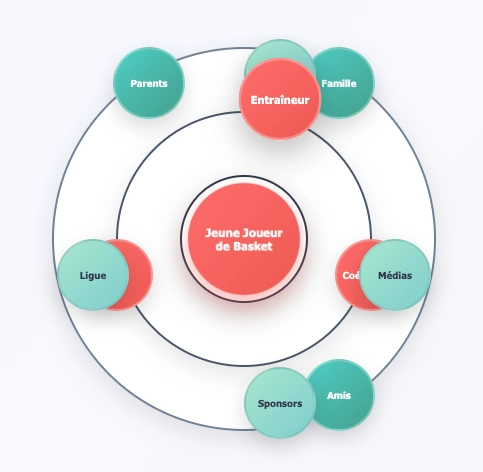
Who and what make up a young athlete's environment:
🏀 A balanced ecosystem for the young athlete’s optimal development
Who are the parents?
Within what we might call the "broad parent group," a wide variety of profiles coexist:
- Parents
- Parent-coaches
- Parents in leadership roles
- Volunteer parents
- Parent officials (referees...)
- Parents in administrative roles
- Parents who are teachers
- Parents of students
It's impossible to overlook the role of parents in success, given how essential their presence and involvement are to an athlete's sport and life.
Different types of parents
Among the parents who "push" are:
- Parent-coaches
- Parents as primary supporters
- Non-sporty parents
- Knowledgeable parents
Among the parents who "hold back" we find:
- Overprotective parents
- Anxious parents
- Parents with difficult personal histories
The work of parenting
Parenting is often a balancing act: it's about finding the art and method of managing daily life while upholding the principles essential to building a child's personality. It's also about being able to adapt them day by day, depending on the circumstances.
There are no simple rules in this field. One exception: learn to listen, even to what's unsaid.
Career stages
For parents there is another variable to consider: the athlete's age and, more precisely, the stage or step in their "career."
- The initiation stage during which young athletes are introduced to competitive sports
- The development stage during which the athlete is recognized as "talented"
- The mastery stage reflecting the athlete's participation at the highest levels of competition
- The cessation stage describing when athletes leave competitive sport
The support guide
That's why we produced this guide. The goal isn't to create "super-parents" but to offer recommendations known to support performance and progress—sporting, academic, and especially the development of the child's personality—despite the challenges faced by stakeholders in this ecosystem.
